Thorens Acoustic Machines
(I don't own)
Hermann Thorens SA St Cross
(This is my translation of the Thorens
portion of this Swiss page: http://www.radiophonomania.ch/histsuisse.htm
--with many additions as noted by square brackets [].)
In the 16 industrial buildings which were built
over the years, the internal combustion engine, which in 1883
generously developed 7 HP, gave way to an installed electric
generator supplying the 2000 kW needed to spread around the
world some 2 to 3
million components and phonographs. Thorens employed in 1928/30
1200 workers and employees.
Commercial representatives in New York - London -
Paris-Brussels-Milan-Frankfurt-Nuemberg-Amsterdam-Copenhagen-Oslo-Stockholm-Helsinki-Lisbon-Madrid-Athens-Alger-Antananarivo-Johannesburg-Sao
Paulo-Buenos
Surface-Caracas-Mexico City-Sydney.
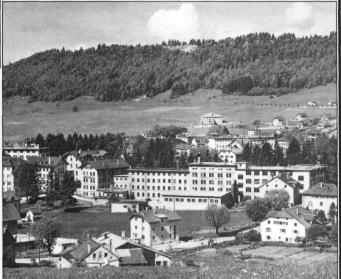
[The below is a picture of Sainte-Croix,
the Thorens –factory (about 1950) “Journal of Mechanical Music”
Spring 2001 page 31]
Cylinder Phonographs
Thorens in 1902 launched their
1st cylinder machines—which were essentially variations of the
American models of the time with harp-shaped sides and aluminium
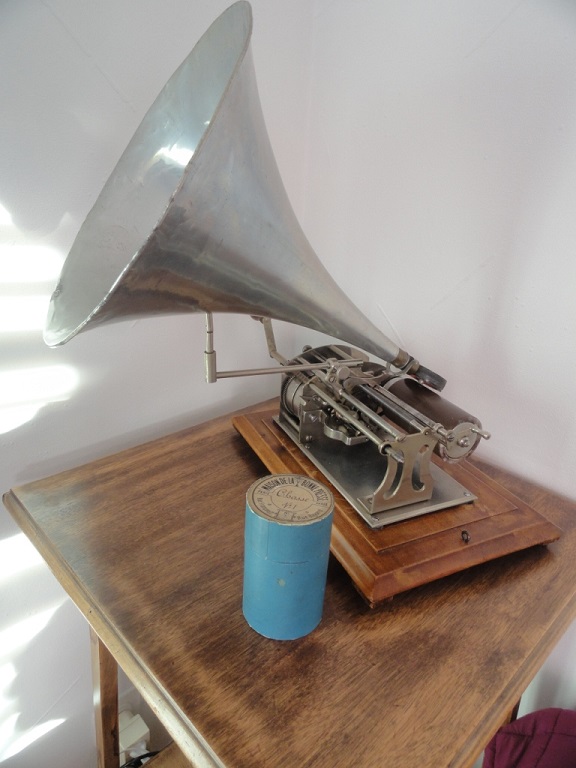
construction. [editor's note: in particular the machine below looks
like
an American Columbia "Q" Graphophone]
[Here
is an example from Roy Jones: <<http://www.radiochest.co.uk/>>.
It
looks like the Thorens "Minerva" as shown below.]

[Picture submitted to http://www.razzarsharp.com/Phonographs/aPhotos.html
by Rolf C. Olsen, Tonsberg, Norway]

[A machine definitely identified by the
collector as a Minerva from the
website <<collection-frioud.ch>>]
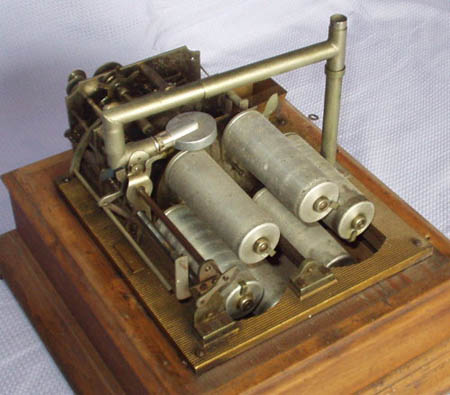
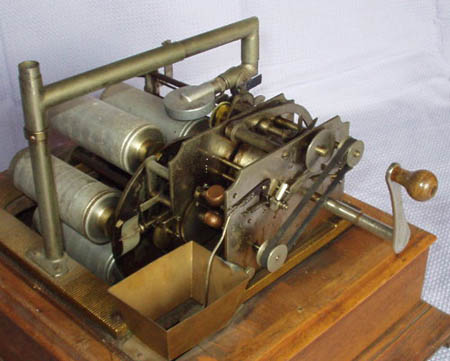
Hexaphone
This phonograph allowed the playing of each of 6
cylinders when placed in a special housing. (Collection
of
P. Caluwé) [editors note: looks like a coin-op mechanism, source
http://www.phonograph.be/paginas/31.Thorens.htm]
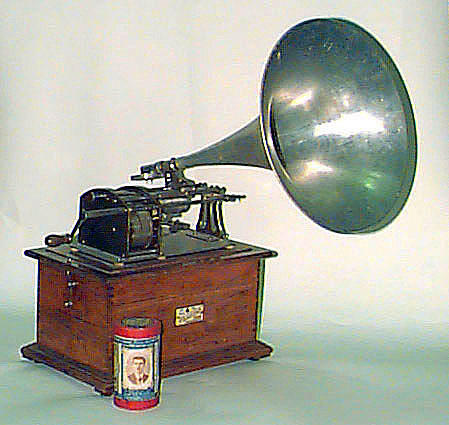
[And here is a Thorens "Cleopatra" cylinder
player from Jean-Paul Agnard. I also have one and it is
shown on my main page. This machine is interesting as it
can be wound left or right handed.]
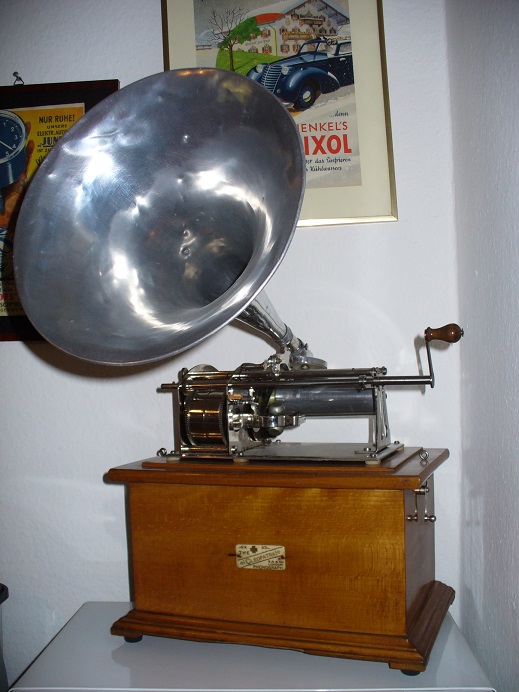
[Rainer Urich also has one although he calls
it a UK machine (all Cleopatras have a London badge) but then
admits the mechanism is Thorens so it should be a Swiss
machine.]
http://rainer-urich.de.tl/Phonographen.htm
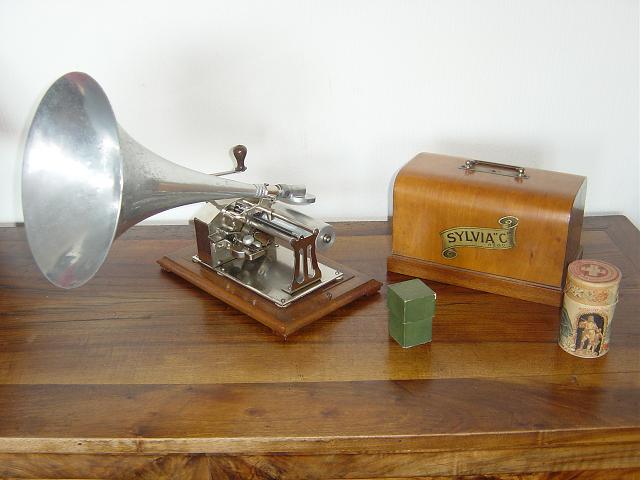
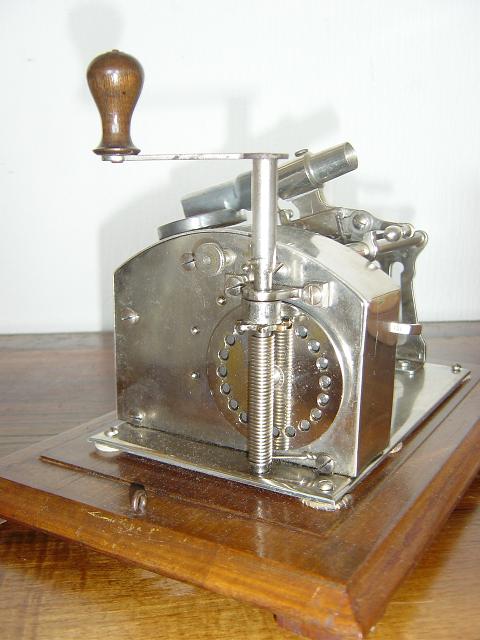
[From the website <<collection-frioud.ch>>
this
is a 'Sylvia "C"'.]
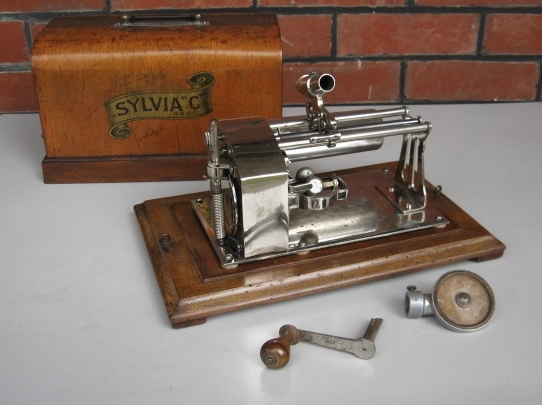
Here is another Sylvia C from eBay, 2013:
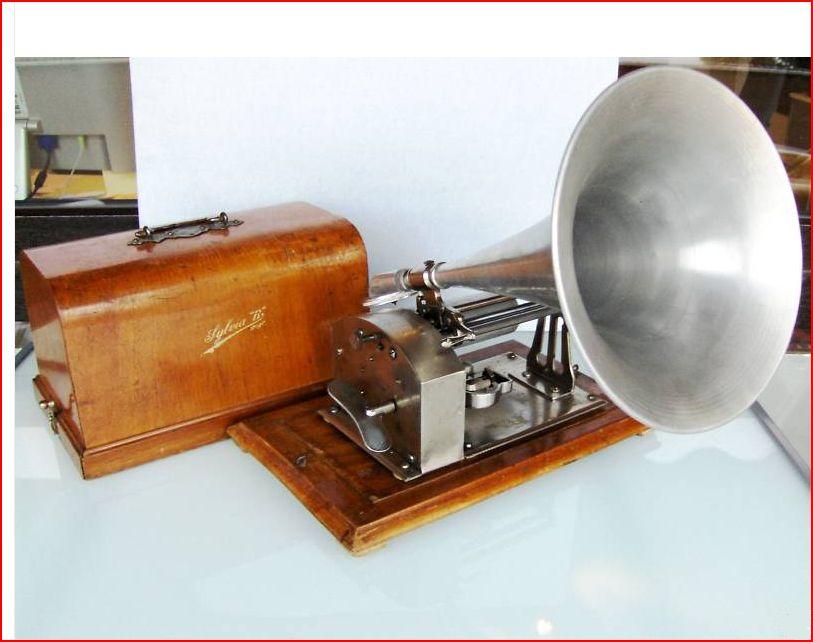
[Manfred Unger of Germany, sent the following
picture of his 'Sylvia "B"'. He has a great website at
<<www.phonographen.com>>.]
Disc
Gramophones
After 1914 there were a wide variety of talking
machines with floral housing, being the fashion matching the
furniture and home interiors which were richly decorated. These
machines could play up to ten 12 inch (30 cm in diameter) discs depending on the
model, as some had up to 4-spring motors.
Thorens "Bijou" from 1907 [Editor's notes: the
reproducer is turned to play 'hill-and-dale' like Pathè; the
1907 Thorens catalog here lists the
Bijou as a much more primitive machine--the owner must be using
the name on the reproducer as the model ID.]
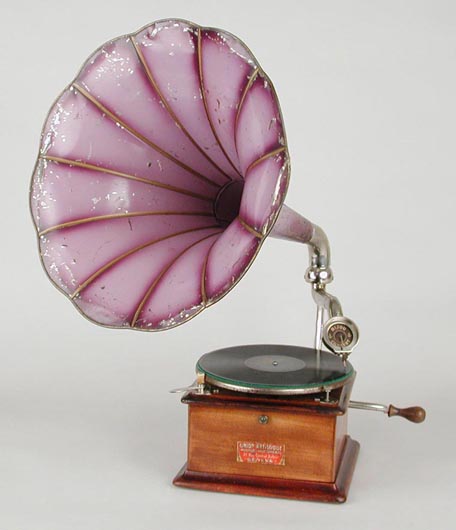
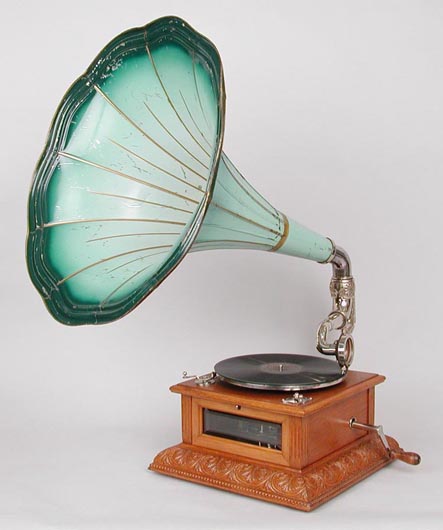
More ornate Thorens from 1914 [Editor's notes:
reproducer now turned to play lateral-cut like
Victor/Columbia; I am unable to match this machine up with any
model from the Thorens 1914 catalog here.]
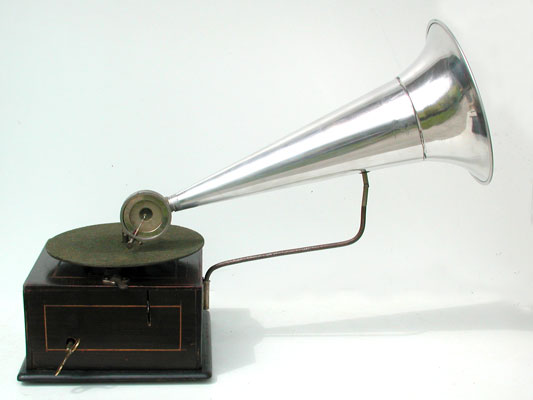
[Below is another machine from
<<grammophon.ch>> that is also labeled as a
Thorens 'Bijou' but dated 1906. It is very much like the
'No. 3 Bijou' in the Thorens catalog identified as being from
1910 here.]
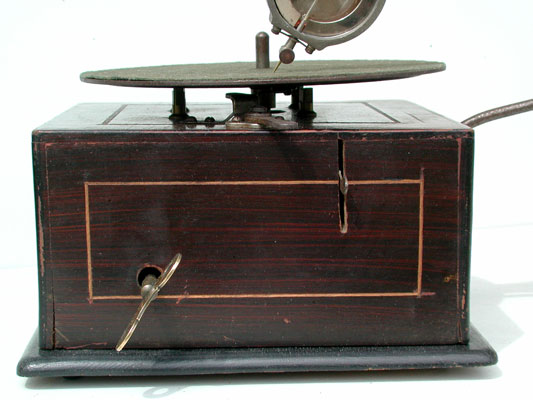
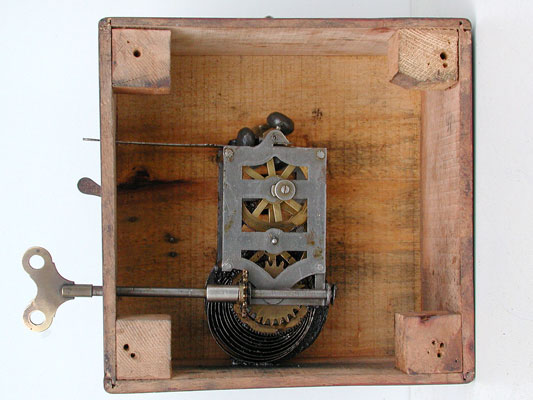
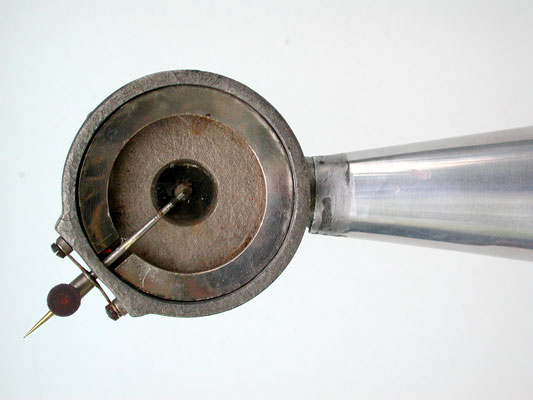
[Original text: One of the first gramophones
made in Switzerland: The "Bijou" by Thorens
The wooden cabinet is similar like the Music Boxes of this
time
The key is build in the tradition of clock-work-makers
The unusual Soundbox made by Thorens]
]
[ From the website
<<collection-frioud.ch>> this is a 'Helvétia' also
from 1906. Note that it looks to be coin
operated. There is a Helvetia in the Thorens 1907
catalog here
and a more appropriate 'No. 316 Helvetia' in the Thorens 1914
catalog here.]
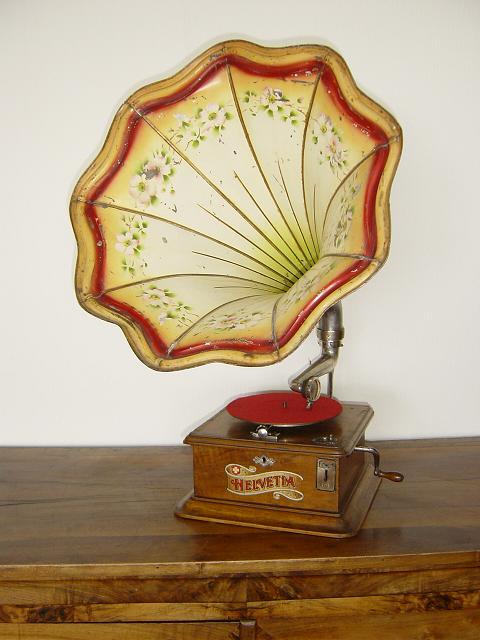

Excelda
Portable Gramophones
Minimal footprint in the form of a camera. The 1st
model dating from 1935 was available only in black with wooden
housing and mica diaphragm. From 1942 available in black, red,
green, grey, blue and brown with metal housing. All finishes are
in cracked painting of the most beautiful effect. End of
production was 1947. There exists a Russian copy of this
device.
[editor's note: the early black machine has the
mica diaphragm, while my machine has a later, metal
'orthophonic' style reproducer. I
have pictures of the Russian one here.]

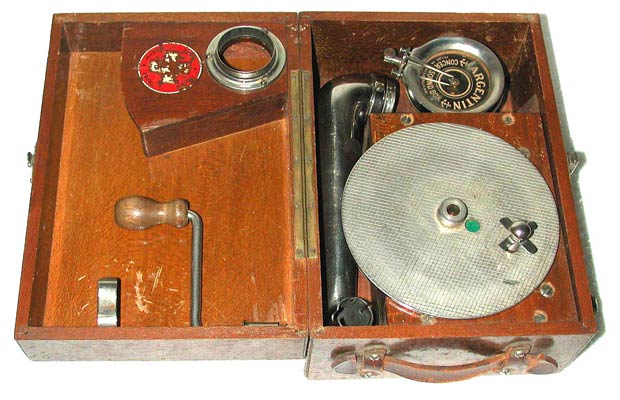
Graphonette
Suitcase gramophone Thorens foldable design:
walnut, mahogany, imitation leather and natural leather.
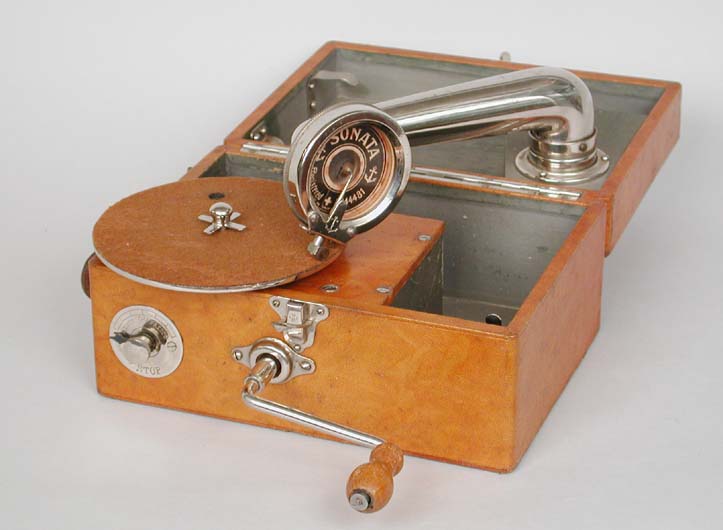
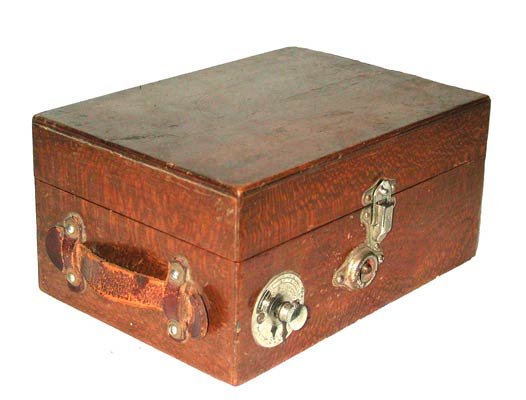
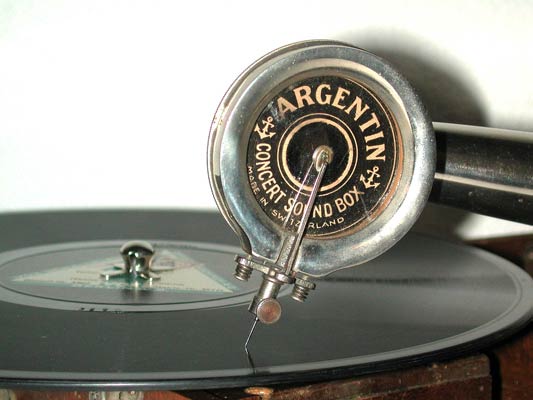
[Below is another machine from
<<grammophon.ch>> that is also labeled as a
'Graphonette' and dated 1925. Note the 'Argentin Concert
Sound Box' sound box instead of 'Sonata'.]
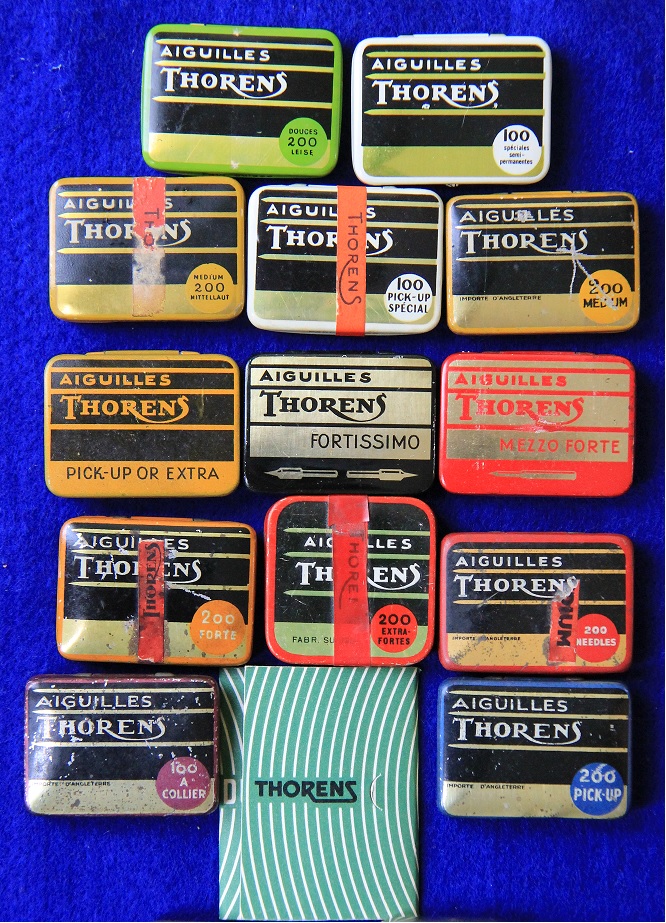
Thorens Needle Tins
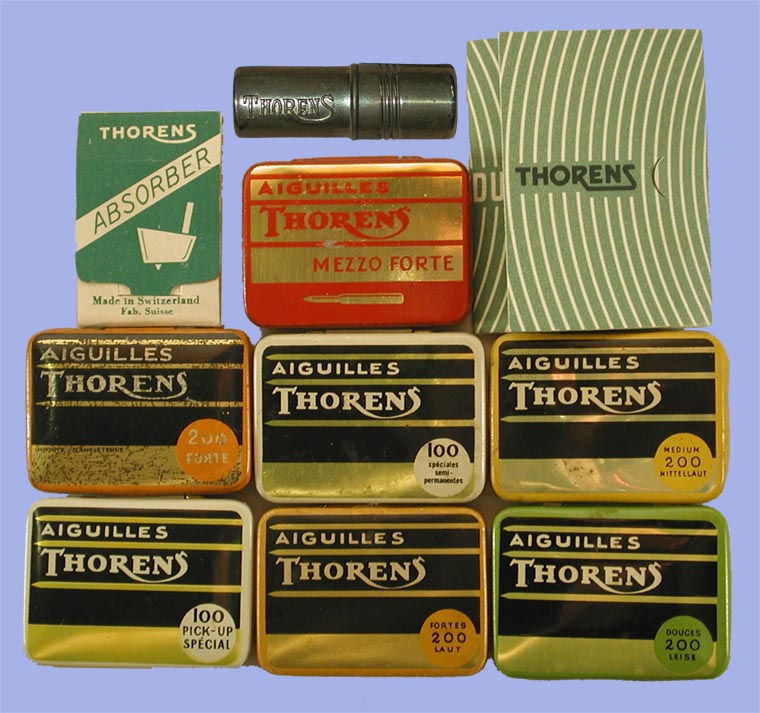
[I have a larger collection here]
Foreign brands
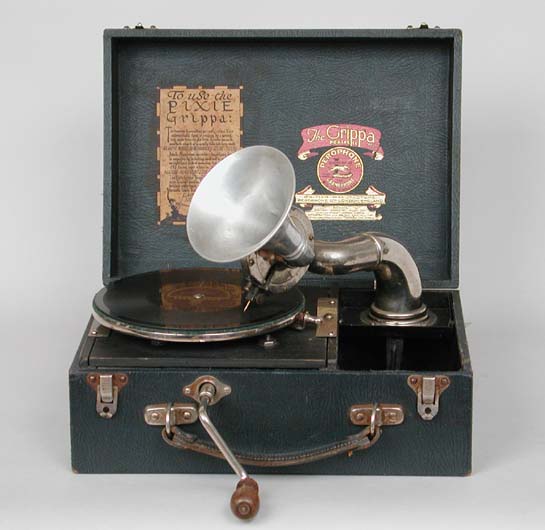
Foreign brands bought complete machines or components from
Thorens. Perophone was the trademark of Vermon Lockwood
Manufacturing Company of London which since the 1910s successfully distributed Columbia gramophones. In the early 20s, the portable
Pixie Grippa had mechanics that came from Thorens. Perophone
distributed under its own name, boxes of needles always
represented by a race dog race with a disc in its mouth. [
editor's note: According to Moogk in Roll Back the Years (1974), "Meanwhile, the
sales of portable gramophones, first promoted during the war
years, rose to new heights in 1926...Mason & Risch of
Toronto was Canadian representative for the Pixie Grippa, which
was available to the retailer for $13."]
[End of Swiss page.]
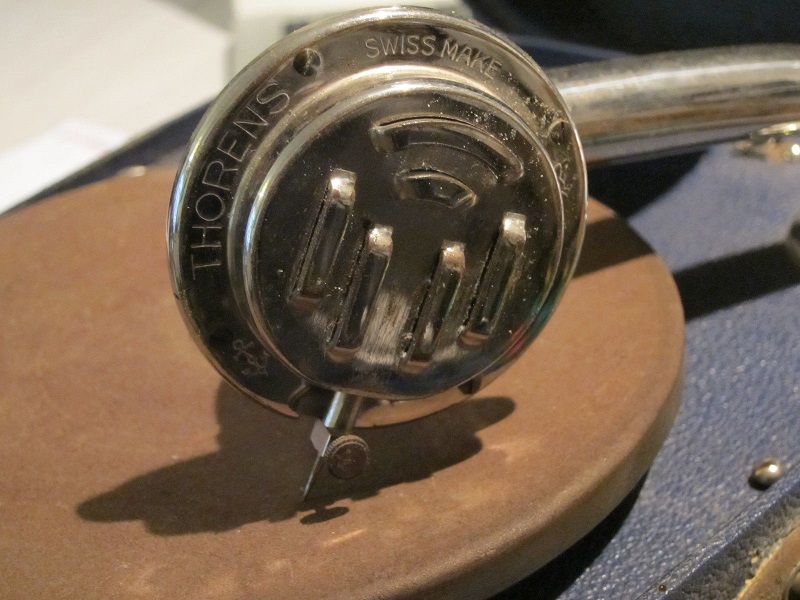
Picture of various Thorens reproducers
from ::the
website <<collection-frioud.ch>>

Unknown portable:


As mentioned elsewhere, I
have made available the 1907, 1910 and 1914 Thorens
catalogs reprinted by the City
of London Phonograph and Gramophone Society.
Back